
Screening vs. sieving in the chemical industry: what’s the difference?
Screening vs. sieving in the chemical industry: what’s the difference?
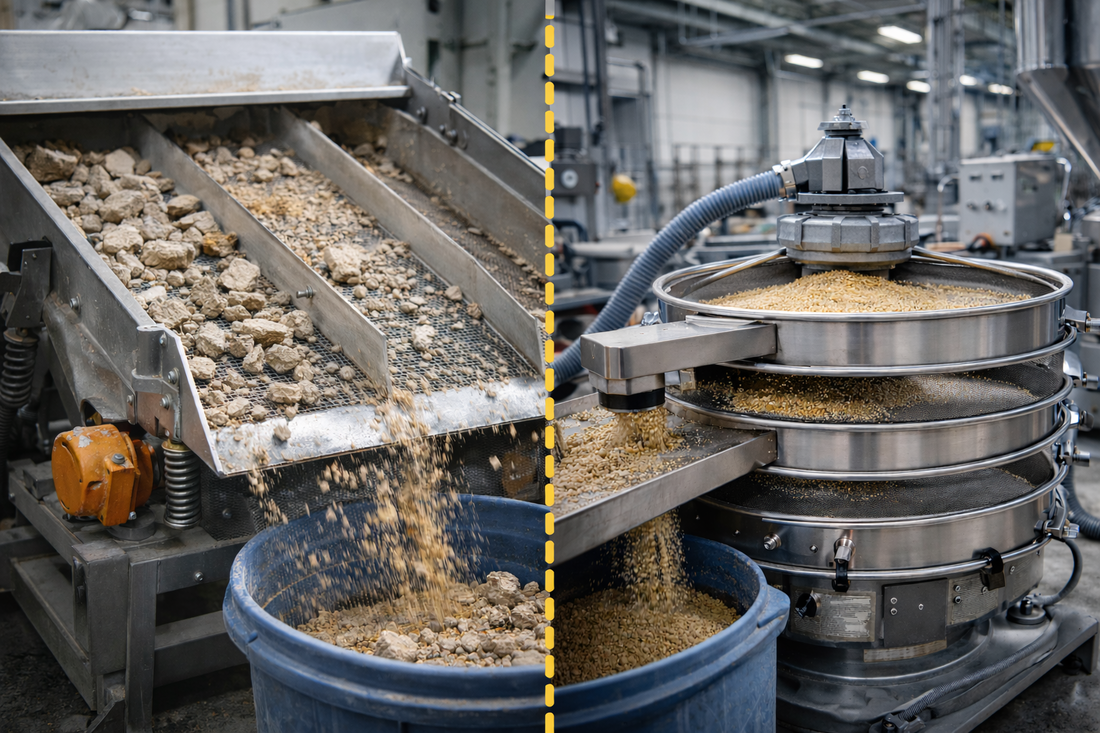
In solids processing, screening and sieving are both particle size classification operations that are often conflated. However, they are not the same: they differ in purpose, size range, process stage, equipment type, and control stringency. At PRO3S we integrate both techniques on certified lines for human food, animal feed, chemicals, detergents, and biocides, ensuring full traceability and regulatory compliance.
What is screening?
Screening uses large-opening meshes/screens to retain coarse particles or foreign bodies at early process stages (raw-material preparation, pre-mixing, or pre-milling).
Operational features
-
Goal: remove oversize, lumps, plastics, fibers, stones, or unwanted fragments.
-
Typical range: > 1–2 mm (can go down to hundreds of microns depending on application).
-
Mode: continuous or semicontinuous, high throughput.
-
Common equipment: linear or circular vibrating screens, bar screens, in-line safety screens.
-
Key benefit: downstream equipment protection (mills, mixers, packers) and stable flow.
What is sieving?
Sieving separates or classifies fine particles with calibrated meshes to tune granulometry and ensure homogeneity, typically at intermediate or final stages before mixing/packing.
Operational features
-
Goal: granulometric refinement, removal of excessive fines/lumps, and achieving specified PSD curves (Particle Size Distribution).
-
Typical range: 20,000 μm → 45 μm (fine meshes), product-dependent.
-
Mode: batch or continuous, in dry or wet conditions.
-
Common equipment: high-precision vibrating sieves, centrifugal sifters, in-line check-sieves, ultrasonic systems to prevent mesh blinding.
-
Key benefit: consistency, accurate dosing, better dissolution/mixing, and sensory/technical quality.
Key differences (at a glance)
-
Process timing:
-
Screening: early or pre-process (preparation).
-
Sieving: mid/final (quality control and refinement).
-
-
Function:
-
Screening: depuration and process safety.
-
Sieving: spec compliance and homogeneity.
-
-
Granulometry:
-
Screening: coarse (mm).
-
Sieving: fine (μm—sub-mm).
-
-
Control:
-
Screening: critical for line protection.
-
Sieving: critical to meet datasheet specs; may be HACCP CCP.
-
Parameters we control at PRO3S
-
Mesh selection and aperture (mesh/μm) per target PSD.
-
Amplitude and frequency of vibration/rotation; residence time.
-
Feed rate and product load (avoid blinding/segregation).
-
Moisture and caking tendency (ultrasonic/centrifugal options for cohesive fines).
-
Cleaning validation to prevent cross-contamination.
-
Batch records (inbound–process–outbound) and release against spec.
Sector-specific applications: concrete examples
Human food
-
Screening: remove foreign bodies and lumps in flours, encapsulated flavors, powder colorants, enzymes prior to mixing.
-
Sieving: tune granulometry in premixes, improve dispersibility and texture; check-sieve before packing to ensure no agglomerates.
-
HACCP: sieving can be a CCP with records and verification (integrated with FSSC 22000).
Animal feed
-
Screening: remove oversize in raw materials and additives (anti-caking agents, minerals) to protect mixers.
-
Sieving: control particle size distribution in premixes and additives to secure homogeneity and accurate dosing.
-
Standards: processes under GMP+ (traceability, validated cleaning, segregation by product families).
Chemicals (inorganic/organic, plastics, paints, construction, textile)
-
Screening: remove nests/lumps in mineral fillers, pigments, fertilizers, polymers, avoiding mill/bagging stoppages.
-
Sieving: fine tuning for rheology, gloss, coverage, reactivity; e.g., classification of TiO₂, carbonates, or silicas.
-
Outcome: stable PSD = repeatable mixing and better mechanical/sensory properties.
Detergents
-
Screening: eliminate coarse grains in builders, bleaching agents, flakes and granules.
-
Sieving: refinement for flowability, dissolution, anti-caking, and uniform appearance in powders; check-sieve before sachets or doypacks.
Biocides & pesticides
-
Screening: remove foreign bodies for line safety and purity compliance.
-
Sieving: adjust size for formulation stability, suspendability, and dosing in industrial/agricultural use.
-
Risk management: segregated rooms and reinforced cleaning protocols.
How we apply it at PRO3S
At PRO3S we design the classification strategy based on product, sector, and datasheet:
-
Inlet safety screening (line protection).
-
Control sieving after milling/mixing (target PSD curve).
-
Check-sieve at packing (retain occasional lumps).
Available equipment: linear/circular vibrating screens, centrifugal sifters, screens with ultrasonic assistance for cohesive fines. Integrated with mixing, milling, granulation, and packing.
Quality & compliance: ISO 9001, ISO 14001, FSSC 22000, GMP+; HACCP; room segregation; 100% traceability and batch documentation ready for customer audit.
Benefits for your product
-
Purity and safety of the final product.
-
Homogeneity and performance in use (dispersion, flow, dissolution).
-
Fewer issues in mixing/packing and greater repeatability.
-
Audited compliance and faster time-to-market.
Need screening/sieving with guarantees and fit-for-spec execution? Let’s talk and design the most efficient flow for your product.